



Table of contents
What Is IPLC? How It Works and When to Use It
For companies with offices, data centers, or partners in different countries, the quality of international connectivity can make or break operations. Public internet connections often introduce unpredictable latency, packet loss, and security risks that become critical when transmitting sensitive financial data, running real-time applications, or synchronizing databases across continents.
An International Private Leased Circuit (IPLC) provides a dedicated, point-to-point connection between two locations, completely separate from the public internet. This article explains how IPLC works, what makes it different from other connectivity options, and in which scenarios it becomes the right choice for your network to connect international offices with dedicated international connectivity.
This article covers
- What an International Private Leased Circuit (IPLC) is and how dedicated international circuits are built.
- How IPLC compares with MPLS VPN, Internet VPN, IP Transit and Ethernet Private Line.
- When IPLC is the right fit for your network and when alternatives may work better.
- How global providers like IPTP Networks deliver low-latency, reliable private connections across continents.
By the end, you will have a clear understanding of whether IPLC is the right choice for your global network and how to evaluate it against alternative connectivity solutions.
What Is an IPLC
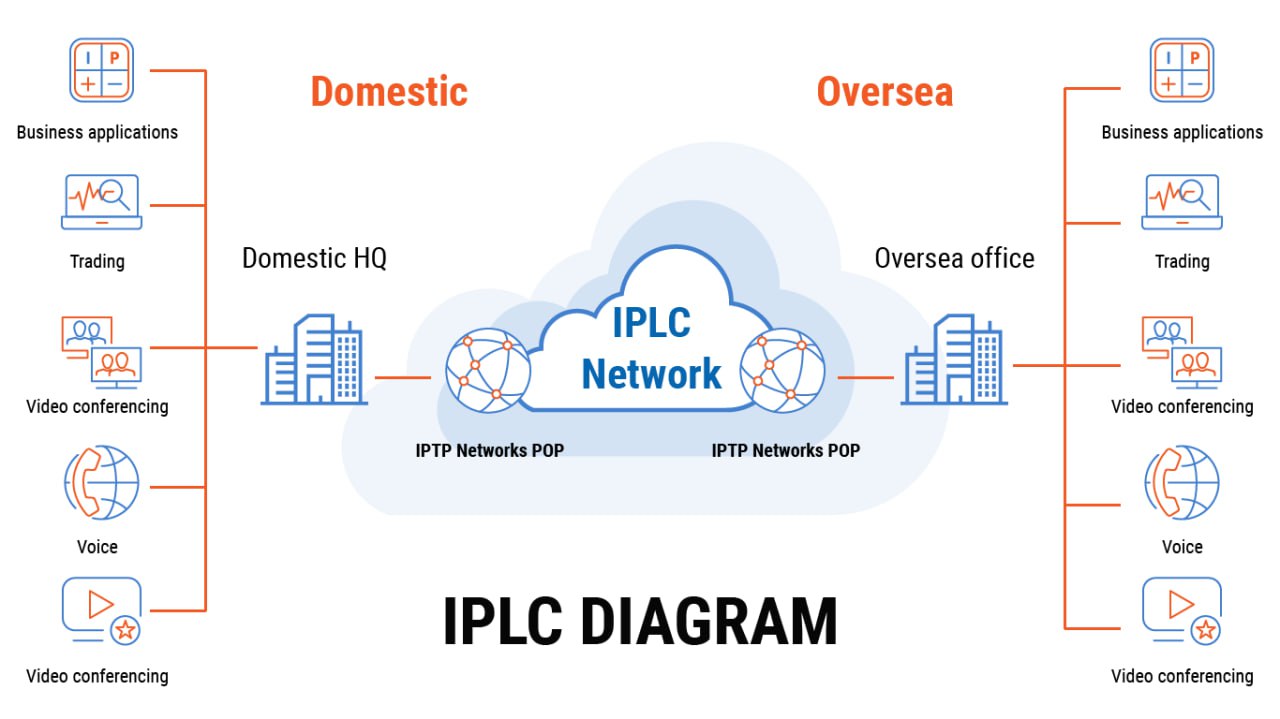
An International Private Leased Circuit (IPLC) is a dedicated point-to-point connection between two geographically separated sites, typically in different countries. The connection is leased from a telecommunications provider and is reserved exclusively for the customer. Unlike internet-based services, an IPLC does not share bandwidth with other users, and traffic travels over private fiber routes managed by the provider.
IPLC connections are commonly used to link headquarters with international branch offices, connect data centers across regions, or establish secure links between trading floors and financial exchanges. The service is delivered with a guaranteed Service Level Agreement (SLA) that covers uptime, latency, and packet delivery.
How Does an IPLC Connection Work
An IPLC is built on physical fiber infrastructure. The provider establishes a dedicated circuit between two customer-designated endpoints, often traversing subsea cables, terrestrial fiber, and carrier-neutral data centers. Traffic passes through the provider’s private backbone rather than the public internet.
Because the circuit is reserved for a single customer, bandwidth is not shared. This ensures that performance remains consistent regardless of congestion elsewhere on the network. The service includes the necessary hardware (routers, switches, optical transceivers) at each endpoint, and the provider handles maintenance, monitoring, and fault resolution through a single point of contact.
Key Benefits of IPLC
A dedicated private circuit delivers several advantages that directly address the limitations of public internet connections. These benefits are built into the service model and are guaranteed through SLAs.
- Predictable latency — With a dedicated path, latency does not fluctuate. This is essential for real-time applications such as voice, video conferencing, and algorithmic trading.
- High reliability — IPLC services are backed by SLAs that typically guarantee 99.9% or higher availability. The provider’s network is designed with redundant paths and equipment to minimize downtime.
- Security and privacy — Since the connection never touches the public internet, data is not exposed to common threats like DDoS attacks, man-in-the-middle interception, or unauthorized access. Only authorized endpoints can communicate over the circuit.
- Dedicated bandwidth — Bandwidth is reserved for the customer. There is no contention, so throughput remains stable even during peak usage.
- Single provider management — When connecting multiple international sites, a single IPLC provider can manage all circuits, simplifying billing, support, and troubleshooting.
IPLC vs Other Connectivity Options
To understand in which cases IPLC is truly the optimal solution, it is useful to compare it with other common international connectivity options. Although all of these technologies are used to transmit data between sites, they differ in architecture, level of traffic isolation, latency predictability, scalability, and cost. Below, we will look at how IPLC differs from MPLS VPN, Internet VPN, and IP Transit, and in which scenarios each of these technologies performs best.
IPLC vs MPLS VPN
MPLS VPN is a private network service that connects multiple sites through a provider’s shared infrastructure. It supports any-to-any connectivity and allows traffic engineering with different classes of service. IPLC, in contrast, is strictly point-to-point. For a company that needs to connect exactly two sites — for example, a headquarters and a disaster recovery center — IPLC offers the simplest and most predictable solution. MPLS becomes advantageous when the network grows beyond two locations and requires full mesh connectivity.
IPLC vs Internet VPN
An Internet VPN (IPsec or SSL) uses the public internet to create encrypted tunnels between sites. It is inexpensive and easy to deploy, but performance depends on internet conditions that are outside the control of the user. Latency spikes, packet loss, and bandwidth contention are common. IPLC eliminates these variables by providing a dedicated, SLA-protected path. For business-critical applications where reliability is paramount, IPLC is the preferred choice.
IPLC vs IP Transit
IP Transit provides public internet access with high bandwidth but no guarantees on latency or privacy, as traffic routes through multiple carriers. IPLC offers a private, end-to-end circuit with SLAs, making it superior for point-to-point links where control and consistency matter more than raw internet scale. This makes IPLC the right fit for organizations that need a private link between countries rather than best-effort public routes.
IPLC vs Ethernet Private Line (EPL)
Ethernet Private Line is a dedicated point-to-point Ethernet service that operates over a provider’s fiber network, much like IPLC. The difference lies in the underlying transport: IPLC traditionally refers to circuits built on SONET/SDH or dedicated wavelength technology, while EPL is Ethernet-native. In practice, many providers offer both with similar performance guarantees. The selection often depends on the required speed, the available infrastructure at the endpoints, and the provider’s footprint.
Decision Matrix: IPLC vs MPLS vs IP Transit
To help infrastructure decision-makers choose the right architecture, here is a quick comparison of when to use each solution:
| Feature | IPLC | MPLS VPN | IP Transit |
|---|---|---|---|
| Connectivity Type | Point-to-point | Any-to-any | Public internet |
| Bandwidth | Dedicated, guaranteed | Shared, QoS-managed | Best-effort |
| Latency | Predictable, low | Managed, variable | Unpredictable |
| Best For | 2 critical sites | Multi-site meshes | High-volume access |
| SLA Uptime | 99.9%+ | 99.9%+ | None |
Common IPLC Use Cases
IPLC is not a universal solution for every connectivity need, but it excels in specific scenarios where stability, security, and predictable performance are non-negotiable. These use cases are especially relevant for finance, multinational corporations, distributed offices and data centers, and organizations with latency-sensitive systems.
- Connecting international offices — a multinational company with headquarters in London and a regional office in Singapore can use an IPLC to run ERP systems, voice, and data sharing with consistent performance.
- Data center interconnection — organizations with data centers in different continents often use IPLC to synchronize databases, replicate storage, and maintain active-active operations with low and predictable latency.
- Financial networks — banks and trading firms require ultra-reliable, low-latency connections between trading venues, clearing houses, and internal systems. IPLC provides the deterministic performance that financial applications demand.
- Global enterprise WAN — large corporations use IPLC to build the core of their wide area network, connecting regional hubs before aggregating smaller sites through MPLS or other services.
Why Companies Choose IPTP Networks for IPLC Connectivity
IPTP Networks operates a global private backbone with more than 228 Points of Presence (PoPs) located in key commercial hubs across Europe, the Americas, Asia, and the Middle East. The company’s infrastructure includes direct access to major subsea cable systems and terrestrial fiber routes, enabling low-latency routes and private connections between countries.
When a customer requests an IPLC, IPTP designs a circuit that uses the most efficient path based on real-time network conditions and historical performance data. The Best Path tool available on the IPTP website allows engineers to check latencies between backbone nodes, giving visibility into the routes that will be used for their connection.
Because IPTP manages the entire infrastructure — from fiber and optical equipment to routing and monitoring — customers receive a single point of contact for design, implementation, and ongoing support. This simplifies operations for companies that would otherwise need to coordinate with multiple local carriers in different countries.
Need Help Designing an International Private Circuit?
Choosing the right connectivity architecture depends on your specific requirements: number of sites, traffic volume, latency sensitivity, and budget. An IPLC may be the optimal choice for your most critical links, while other services can serve branch locations or less sensitive applications.
IPTP Networks engineers can help map out a solution that combines IPLC with MPLS, DIA, or cloud connectivity to meet your global networking needs. Contact us to discuss your requirements or request a proposal for an international private circuit. Request a global leased line quote, international private leased circuit pricing, or contact us for a tailored proposal from an IPLC provider for multinational companies.
IPLC